

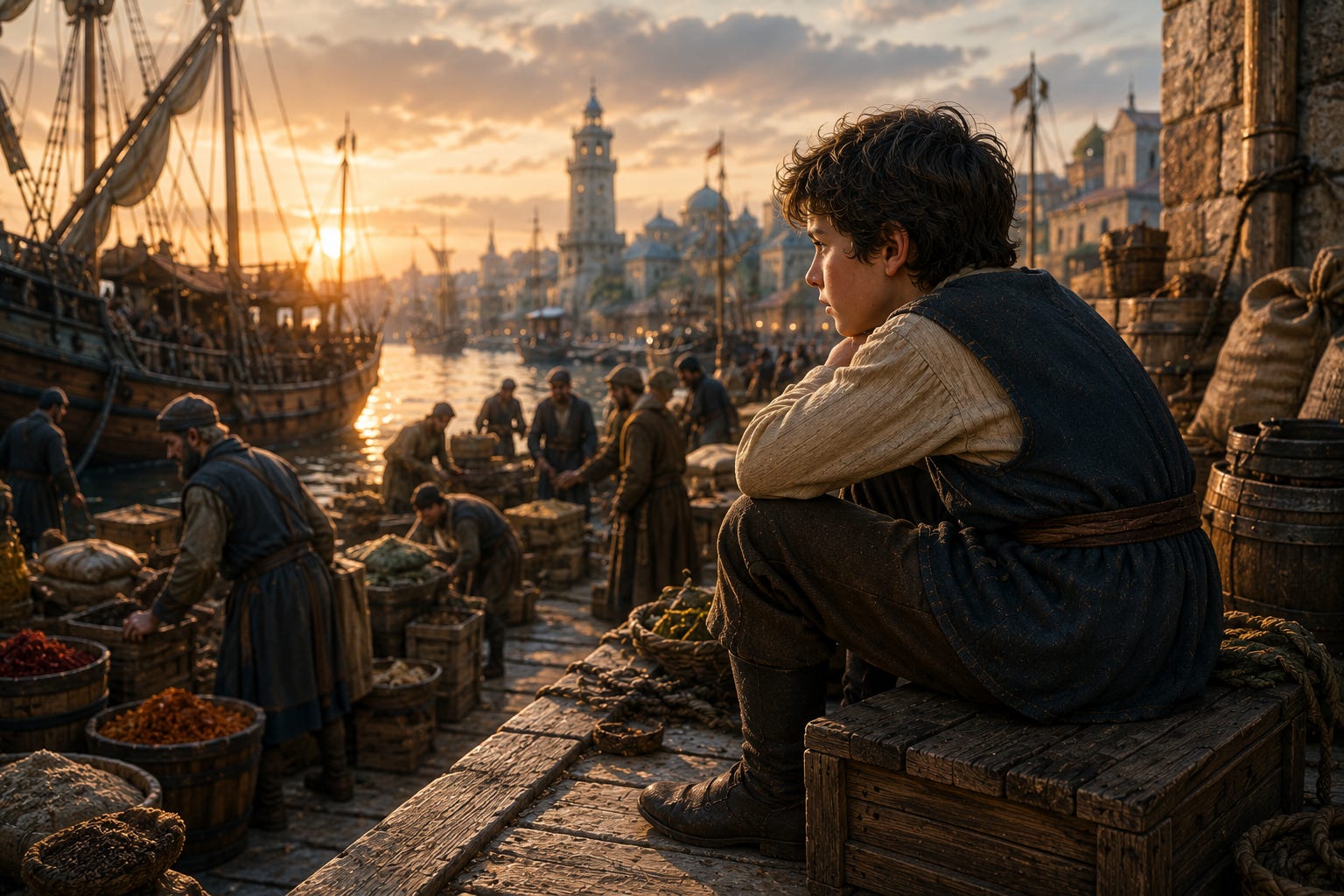
My dear apprentice, before there was a laboratory, before there was an elixir, before there was even the word alchemist attached to my name, there was a boy who could not stop watching.
This is a story about how ventures are truly built, though it will not sound like the ones you have heard before.
I was born the third son of a scribe in the river city of Corvana, in a narrow house three streets back from the water. My father copied contracts for merchants rich enough to need them but unable to write their own names. My two older brothers were, from the earliest age I can remember, exactly what was expected of them. Practical. Steady. I was not made the way they were made. I say this the way you might describe a fault line in stone, a place where the rock was always going to split differently, long before anyone struck it with a hammer.
From the time I could walk unassisted, I made my way to the docks whenever I was permitted, and often when I was not. I would find a place to sit, usually atop an overturned crate near the fish market, and I would simply watch, for hours, if no one came looking for me. Looking back now, I understand I was doing something more particular than watching. I was beginning to notice patterns. And the pattern that fascinated me most was the pattern of who rose and who fell.
Let me tell you about three men I watched more closely than almost anyone else.
The first was a spice trader named Bellamy, whose stall, for a time, was the busiest on that stretch of the docks. He had a gift for knowing exactly what a customer wanted before they finished asking. And then, over the span of two years, I watched it all come apart. Not one great catastrophe, but smaller failures compounding: a trusted partner who absconded with a shipment’s proceeds, a rival stall that undercut his prices at the worst possible season, a run of bad weather that cost him customers he never won back. By the time I was ten, Bellamy’s stall stood empty, and not long after, it did not stand at all.
There was another man I watched nearly as closely, though for a long time I did not understand why he unsettled me. His name was Corliss, and he had inherited the largest grain warehouse on the waterfront. Corliss was neither especially clever nor especially kind, and yet he prospered without visible effort, in a manner that made no sense against the pattern I was beginning to trace. My father told me, gently, that some men are given the mountain, and other men must climb one. I did not yet have the maturity to hold two truths at once: that inherited advantage was real, and that the harder path of noticing a gap and closing it remained the only path available to a boy with no warehouse waiting for him. What I understand now is that Corliss taught me something valuable in spite of himself. Not everyone who prospers has earned the right to teach you anything. Some fortunes are simply weather.
It was against this backdrop, Bellamy fallen, Corliss unaccountably risen, that I began to watch a boat-builder named Osric.
Osric built small river craft, nothing remarkable to my young eyes at first. But he had noticed something the other builders had not. Every flood season, half the fishing fleet sat useless, unable to navigate the swollen river, and every builder on that stretch treated this as simply the nature of things, a cost of doing business that could not be solved, only endured. Osric refused to accept this. He began experimenting with a new hull design, and I want to tell you about one particular failure of his, because I watched it happen, and it taught me more than any summary could.
Late in his second season of testing, Osric brought a hull he was genuinely satisfied with down to the water. It held for perhaps forty strokes of the oar before the seam near the bow simply gave way, dumping him and a hand into the shallow river to the laughter of the neighboring yards. What surprised me was what he did next. He did not curse the wood or the river. He dragged the pieces to the bank and spent the afternoon, in full view of everyone who had laughed, tracing the seam that had failed, saying very little. He was not merely failing. He was interrogating his failure, extracting the one piece of information that mattered, so the next hull might fail differently, or not at all.
He failed perhaps a dozen more times before the following spring, when the floods came again and three of his boats held. Not perfectly. Well enough. By the time I was eleven, Osric’s yard had doubled, and builders who once mocked his wasted timber were quietly asking to learn his method.
Here is what I understand now, looking back across the whole distance of my life, that I could only sense as a shape without an outline then. Bellamy’s success depended on conditions he never controlled and never questioned. Corliss’s success taught a watching boy nothing repeatable at all. Osric, alone among the three, had noticed a real, recurring need that an entire trade had simply agreed to endure, and he had seen the gap before he had any idea how to close it. The seeing came first. The solution came later, and only through failure.
I began, without quite deciding to, keeping a private accounting of my own. Nothing so formal as a ledger yet. Just a habit of asking, silently, what is the thing here that everyone has simply agreed to live with.
My eldest brother, Tomas, found me on our rooftop one evening and asked what kept drawing me back there each night. When I told him, he said something I have carried with me since: that he had never once looked at the world and felt it was trying to tell him something the way I seemed to. He told me a house needs both kinds of sons, the ones who keep it standing and the ones who ask what it might yet become, and that I should not let our father mistake my restlessness for a fault rather than simply a different shape.
My father did not share Tomas’s ease with what I was becoming. One evening, he found me sketching Osric’s hull design instead of practicing my letters, and asked, quietly, what I thought I would do with such a thing. I did not have an answer. He told me that noticing was a fine thing for a scholar, but a poor substitute for a trade, that the docks were full of men who saw problems clearly and died poor all the same, because seeing a gap and closing it were two entirely different arts. He was both right and incomplete. Right, because a mind that only sees and never acts is a real danger. Incomplete, because he assumed the seeing itself was worthless without the doing, and I would spend the next fifteen years learning exactly how wrong that assumption was.
I want to close with a story that does not reflect well on me, because I have come to believe those are often the ones most worth telling. I had watched the porters of Corvana suffer the same crooked, aging injury for years, carrying grain in straps that had always been cut the same narrow way. At twelve, I built my own version, wider and padded, certain I had solved something real. I brought it to a porter named Fennick, expecting gratitude. What I received instead was a patient correction: a strap built by a boy who has never carried a load is a strap built for the boy’s idea of carrying, not for the carrying itself. I had solved a problem I had only observed from twenty paces away, never from inside it.
I did not abandon the idea. I went back and, for weeks, simply helped, carrying lighter parcels, coiling rope, until I understood the problem from the inside rather than the outside. My second attempt was smaller in its ambition and better for it. Fennick used it. More importantly, I overheard him say so to another porter, plainly, as a small fact rather than a joke: the boy’s second try was better than his first.
That evening, I opened a plain notebook I had been given the previous winter and used for nothing until then, and by candlelight, I wrote down honestly what the strap had actually cost me and taught me. I did not call it a ledger. I did not call it anything at all. It was simply a boy’s private page, the very first one, though I would not understand its significance for years.
Before you go about your work this week, walk through whatever venture, or trade, or ambition occupies your days, and ask yourself honestly: what is the thing here that everyone around you has simply agreed to endure, rather than solve? You need not have the answer. Osric did not, not for a long while. You need only learn to see it clearly, and to trust that the seeing itself is the beginning of something, even when you cannot yet say what.
Eldric & The Entrepreneurial Elixirs is published by ProfSpirit LLC.

Continue below for the Alchemist’s Ledger: the pattern that separated Osric from Bellamy and Corliss, distilled into a seven-day practice for spotting the opportunity in your own venture.
